

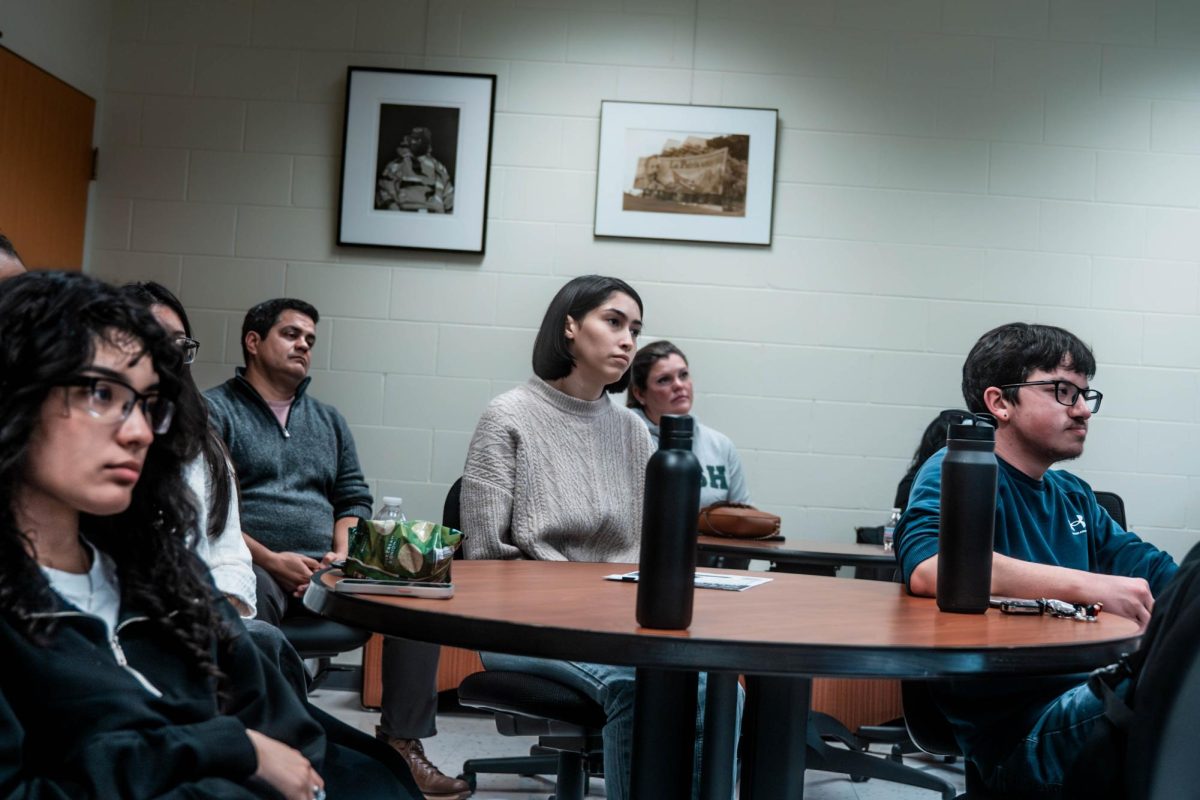
The ECC administration cancelled a “Palestinian Voices” event organized by The Center for Civic Engagement (CCE) citing the “sensitive nature of the topic.”
“The event was scheduled for November 11th,” said Antonio Ramirez, the CCE’s director. “And they [ECC administration] told us at two p.m. on Friday October 31st” that the event was cancelled.
Ramirez stated that the CCE had been planning a three-part speaker series, and the second part was supposed to be “The Palestinian Voices” event, which they had been planning since September.
“The speaker was actually going to zoom in some of her students from Egypt, who were Palestinian students, who still had family in Gaza,” said Ramirez, who is also an Associate Professor of History. “So the opportunity was going to be for students here on campus to hear directly from other students who had to leave their home country and whose families were living in a war zone from their perspective.”
According to ECC’s website, the CCE seeks “foster skills and experiences” that students “need to be thoughtful and engaged civic leaders on campus, in their communities, and in our democracy.”
“The planned “Voices of Palestine” event’s proposed format did not include representation or perspectives that would provide the necessary balance for a topic involving an ongoing international conflict,” according to a college statement released by ECC’s Director of Communications, Andrea Watson. “Because the event fell outside of the CCE’s scope, the College decided to cancel the event in its current form.”
According to the Office of the Historian, the Arab- Israeli war can be dated all the way back to 1948 upon the invasion of Palestinian land by Jews who claimed to have religious connection to this land.
“The Gaza and Israel conflict has been going on for 17 years,” said Isa Aman, a first-year ECC student. “Israel took over Palestinian land, and voices are being silenced. Coming together to host an event and create awareness, sharing stories, culture, and displaying unity in the community is important.”
The Israel-Hamas War was reignited from a surprise attack by Hamas to Israel on October 7,2023, according to an article from the International Rescue Committee.
“Usually people don’t know the background or history of things like this,” Aman said. “If you refuse to have these conversations or events, then you’re basically supporting an ethnic cleansing, a genocide.”
“This decision is not about limiting discussion or academic freedom,” according to an ECC statement. “However, when an event is organized under the banner of a college-sponsored center, the College has a responsibility to ensure that it complies with established guidelines for neutrality and fairness.”
Ramirez explained the rationale behind the proposed event.
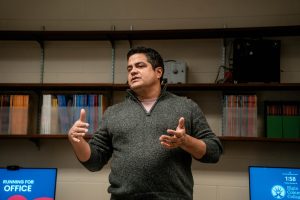
“It was about them [the guests] sharing their experiences as Palestinians, and then talking about in their perspective [on] what’s one of the most important geopolitical events that’s happening in the world right now,” he said.
According to the Gaza Ministry of Health Statistics, more than 170,000 Palestinian civilians have been injured, and over 68,000 killed due to Israel’s retaliation against Hamas.
“There is no way you can be inclusive if you’re excluding Palestinian voices,” Aman said. “Everyone is always so vocal when it comes to other civil rights events, but when it comes to the Muslim community no one is vocal.”
She expressed that she believed the cancellation of this event is rooted in Islamophobia.
“The suppression of oppressed voices highlights the lack of knowledge and ignorance of people, and it is due to normalization of Islamophobia,” Aman said.
“Elgin Community College values open dialogue, critical thinking, and conversations that explore a wide range of perspectives, including those on difficult and complex issues,” according to the college’s statement. “Additionally, because the Center is college-sponsored and publicly funded, it is required to ensure that all programs it hosts are balanced and representative of diverse viewpoints. These guidelines help create an environment where all students feel welcome to engage, regardless of their personal or political beliefs.”
A graduating ECC student who wished to be unnamed disagreed with the college’s decision.
“Why not ask the CCE to restructure the event instead of canceling the event?” he said. “Cancelling the event so late gives the impression that they [ECC] don’t agree with the topic in general or have some sort of bias. I know a lot of other colleges have had talks about Gaza.”
For months last year, college students across the nation had student-led protests related to the Gaza conflict.
“I think it was a mistake on behalf of the college because one of our core values at ECC,” Ramirez said. “One of them is freedom of inquiry.”
“I feel like the fact that the college denied this event from happening is even more proof that events like this should happen,” he said. “People need to be more educated about what’s happening around the world because if not they tend to fall back into stereotypes and fear, and make decisions out of those emotions.”
![[File photo] First semester Industrial Engineer Student Josiah Matthews discusses how he enjoys the challenges that come with complex math problems with staff writer Viviana Avila. Photo Taken in the D building Hallway](https://elginobserver.com/wp-content/uploads/2025/09/Josiah-Matthews-1-Math-1200x800.jpg)
![[FILE PHOTO] ECC's TRiO services on March 24, 2026, are currently available Monday-Thursday from 8:00 a.m-7:00 p.m, and Friday from 8:00 a.m-4:00 p.m. TRiO is one of the few offices available to students enrolled in night classes.](https://elginobserver.com/wp-content/uploads/2026/03/IMG_8423-1200x800.jpg)