


Being a student journalist comes with its challenges; however, we are duty bound to report the facts, trusted to shed light on important issues within our communities, and provide a platform for people of all walks of life to tell their stories. As a student journalist, I try to remain objective and consistently follow journalistic practice.
As a student leader who serves as an editor-in-chief, I am not opposed to following the college’s processes and procedures as it relates to the media. However, I, along with my peers, believe those processes and procedures should be applied consistently and clearly defined beforehand.
Despite my training from a professional, who is also my adviser, I have recently experienced the displeasure of being ‘othered.’ I have been made to feel like I’m inferior or an outsider by the very individuals within the institution I aim to serve, particularly Elgin Community College’s Director of Communications, Andrea Watson.
I am a Black woman living in America, so I have had many experiences of being alienated or made to feel less than, but this one hurt a little differently. Not only was I being othered by someone within the very institution I love, but by a woman who has past experience in journalism, and is also a black woman.
My team members who also serve on our student-run news publication, the Observer have also been made to feel the same way. These experiences cast extremely dark shadows over the hard work each student journalist puts in and makes objective reporting significantly more challenging.
Several instances of being othered with the goals of censorship and gatekeeping the truth occurred a few times before my personal experiences. They started off as subtle yet still very disheartening. Here are a few examples:
In Sept. 2025 an email was sent from Watson to Daniel Garcia strongly encouraging him to include the colleges’ statement after publishing a story on a student being detained by ICE on campus. The statement was sent after the reporter’s deadline, and the reporter was repeatedly asked to include the college’s statement even after the reporter explained that it would be addressed in a follow-up story.
On Oct.14, 2025 Photography Editor, JP Ramos covered the Board of Trustees meeting and was attempting to take pictures of the board members when Watson approached him and made him sit in the press/media section. Ramos was using a Sony handheld camera as he was not there to cover the meeting but to get six photo shots and leave. The size of his equipment was not obstructing anyone’s view of the meeting’s proceedings.
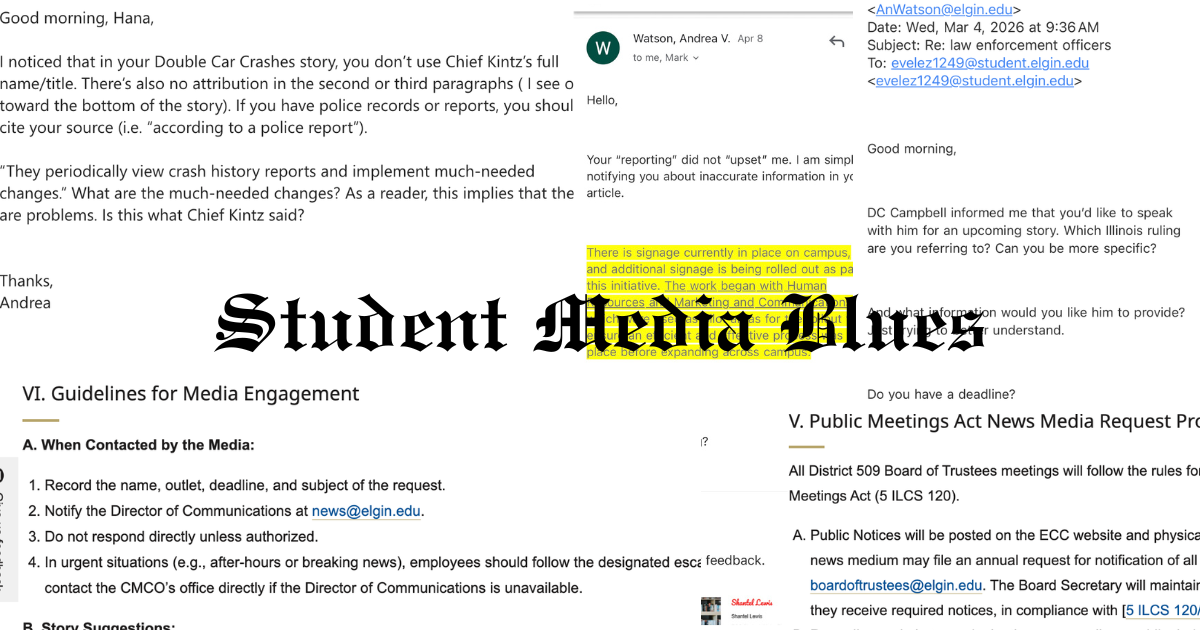
Oct.15, 2025, Hana Keck was sent an email from Watson critiquing her published article. The team expects critique to come from each other, the editorial team, and the advisor, not from the Communications and Marketing Department.
Oct. 31, Senior Director of Content and Creative Services, Scott Piner (Communications Department) emailed Observer team member Michael Oswald Jr., instructing him to remove a now ECC alumni from our website. Again, we expect feedback and direction to come from within our group, not outside of our group. We are not a part of the Communications and Marketing Department. This is the equivalent of walking into a business and telling the staff items that need improvement. It’s inappropriate behavior and causes us to feel unsupported and as if we can’t make mistakes.
On Oct. 22, 2025, Watson directed student journalists to sit in a media /press section, implying that the Observer students could not sit anywhere at a public meeting. This made us feel unwelcome while covering a meeting that is central to an institution we attend. We also contacted the Student Press Law Center and were informed by an attorney that journalists are able to sit anywhere we like in a public meeting under Illinois law regarding public meetings.
On Nov. 20, 2025, I reached out to Chief Institutional Success and Engagement Officer Jocelyn Santana via email for an interview, as I wanted to write a story on Muslim representation. On Nov. 21, 2026, I was contacted by Watson via email to “help coordinate” an interview with Santana, but before she could do that, I had to disclose the angle of my story and provide her with the questions I would ask beforehand.
Watson also stated that she wasn’t aware of what Santana’s availability was.
I responded to Watson by providing her with a synopsis of my story, and that sending questions via email was not considered journalistic practice. She responded three days later on Nov. 24, 2025 via email saying “Jocelyn informed me that she is out of the office.”
For nearly a week, I was halted in getting an interview, and then an interview was not an option. I was attempting to include as many voices and perspectives in the story, and I was prevented from doing so, despite following the college’s protocol.
My peers and I are routinely asked to provide questions before our interviews with ECC employees, primarily those who are administrators. We give overviews of what our stories are about so interview subjects do not walk into interviews blind, but we repeatedly have to say that giving questions before an interview is against standard journalistic practice.
On Dec.9, 2025, Garcia was covering the Board of Trustee’s meeting (open to the public) when Watson approached him, insisting that he move to the designated “media section” where she then sat directly behind him the entire time.
Garcia expressed that he had trouble hearing during the meeting due to impairments and sitting so far away.
Watson repeated this same action again, on Jan. 27, 2026 forcing my peer Ramos, and me to move to a designated press section while covering a trustee meeting. This clearly violated our rights. Reluctantly, we moved to the seats with an obstructed view, which she pointed to.
On March 4, 2026, Watson reached out to Observer team member Eva Velez, after Velez requested an interview with Deputy Chief Craig Campbell about use of force in Elgin.. She instructed Velez to be ‘more specific” of what she wanted to know and the information she wanted Chief Campbell to provide.
This left Velez confused. She didn’t understand why Watson served as a middle person, instead of hearing from Campbell himself. The college’s media policy states that the employee contacts the Director of Communications, not the journalist. Velez said she had already completed her article by the time Watson contacted her. Once again, our attempts to include various voices and perspectives in our articles were hindered by delay tactics.
On March 31, 2026, Watson emailed Velez saying, “You do not need to contact me first for stories, but in the end, you and I will still end up communicating once an employee lets me know you’ve reached out.” Watson stated that “ECC is not much different from communications/media relations at any other company or university.”
Again, the Observer staff is willing to adhere to company policies, but we need timely responses and effective collaboration. In our initial emails to interview subjects, we include our deadline, so they are aware of our timeline. Having to coordinate with Watson significantly slows down our timeline. A key part of journalism is timeliness. We can’t afford to be given the run around for several days or even weeks. This hinders us from meeting our deadlines.
Also, we are not just working for the Observer. We are also students, and most of us have jobs. The back-and-forth in emails makes our jobs harder.
Most recently, I was tasked with reporting on ICE signage that would protect immigrant students on campus. After thoroughly investigating and reporting, my article was published.
On April 8, 2026, I was contacted by Watson via email as she stated “ECC Communications was not contacted prior to publication to confirm details or provide context.” She said, “please let me know if you are able to update the article to reflect accurate information.”
The tone of the long email came off as passive-aggressive and insinuated that I am not an accurate reporter or credible. This further me feeling othered by Watson.
Though I have only listed a few instances, there have been a plethora of uncomfortable interactions that have continued throughout the summer.
The many ways Watson has made me feel othered have been due to her dismissive attitude. This includes ignoring me after greeting her on campus, treating me as if I’m less credible, employing delaying tactics that prevented me from making deadlines when reporting on sensitive topics, facilitating interviews with other faculty and administration members instead of speaking to them directly, and being made to feel as if I was being perceived as a problem or agitator.
This sends a clear message that certain voices, stories, and perspectives are not valued, and silencing them when they become too loud through censorship is the Communications Department’s way forward. This limits the voices of students, families, and surrounding communities.
The way forward is not to become offended when an issue or topic is brought up, but to fill those gaps with inclusion, cultural sensitivity, empathy, awareness, and encouraging healthy conversations, no matter how sensitive the subject matter is. It is a healthy way to ensure every student has a sense of belonging, adequate representation, and continued Spartan Pride.
Student journalists also should be unhindered in reporting on matters deemed newsworthy by the staff and the student body. We report the good, the bad, and the ugly, but it all matters. We strive to be fair, accurate, and balanced in our reporting, but that is difficult to do when trying to interview some ECC employees.
I hope Mrs. Watson and her peers in Communications and Marketing do not see this editorial as a personal attack but as a way to self-reflect and an opportunity for growth. I hope that Watson and the college administration will make greater efforts to ensure the First Amendment is protected for the Observer staff and all members of the ECC community.


Yesenia • Jun 25, 2026 at 4:39 pm
I admire your bravery for writing about your experience!