
As fall begins, much of ECC’s wildlife is preparing to go dormant. That includes prairie plants that purify the air. While they may seem to be dying, they are actually hibernating.
During dormancy, the plant dies, but that’s not the end.
Underneath the plant, its roots sprout, creating life where death once existed. It’s like a resurrection in nature.
“The roots are going to be metabolizing, staying in cellular respiration very slowly throughout the entire wintertime,” said Biology Professor Frederick Vogt.
Once spring arrives, the roots aid in the regrowth of the surface part of the plant.
“When the spring rains return, the soil warms up. The roots grow the next part of the plant that you see coming out of the soil,” Vogt said.
The roots can extend all the way down to “10 feet or beyond into the soil,” Vogt said.

There is more than one type of prairie plant. Many of them perform the same type of process at around the same time.
Some species can be found on ECC’s campus.
These include yellow and blue Coneflowers, milkweed, golden rod, white and blue aster, compass plants, and cup plants,” Vogt said.
Collectively, these plants make up a prairie.
“A prairie is a naturalized space that has native plants in it to the region and climate,” said Director of Building Services and Grounds Ryan Callahan.
It is also “defined as a grassland, and it is characterized by a predictable summertime drought and a summer fire season,” Vogt said.
The plants in the prairie aren’t just for show; they play a vital role in the environment by acting as air and water filtration systems.
Here’s how it works: Prairies absorb pollutants such as, carbon dioxide, from the air, and they remove them from the air; thereby naturally filtrating the air.
When water seeps through the prairie’s soil, pollutants such as, pesticides, as absorbed into the soil; thereby naturally filtrating the water supply.
“It all starts out with the porosity of the soil. The soil acts as a medium[channel] that filters out materials in the water,” Vogt said.
Once the water flows through the soil, it gradually gets cleaned out. This includes material that could pollute the water supply if it were left unchecked.
“As water is percolating through the soils that make up prairies, the water becomes purified by the different size of the soil particles. They filter out the material and water you don’t want getting into the water supply,” Vogt said.
Prairies have working networks that support each other to complete the same process.
“There’s microorganisms that live in the soil that purify the water as well. So prairies work as a water purification system in a water storage system,” Vogt said.
Prairies can also act as air pollution containers and combat global issues at the same time.
“A lot of CO2 [carbon dioxide] gets stored into the soil that makes up prairies, so it becomes a sink to store carbon dioxide that contributes to climate change,” Vogt said.
Air and water filtration aren’t the only beneficial parts of prairies; they are also essential for agriculture.
“That is where a lot of our soils come from, that can be used for agriculture. Prairies are critical because most of the resources that are required for plant growth are stored in the soils and prairies,” Vogt said.
With the absence of these prairies, there could be consequences that follow suit.
“Without them, there’s no ability to store water and to purify water, many of the pollinators that farmers need for their crops won’t be around anymore, because they live in amongst the prairie plants,” Vogt said.
It’s like a ripple effect; once pollinators are out, crops would be in danger of not being able to be produced for people to consume.
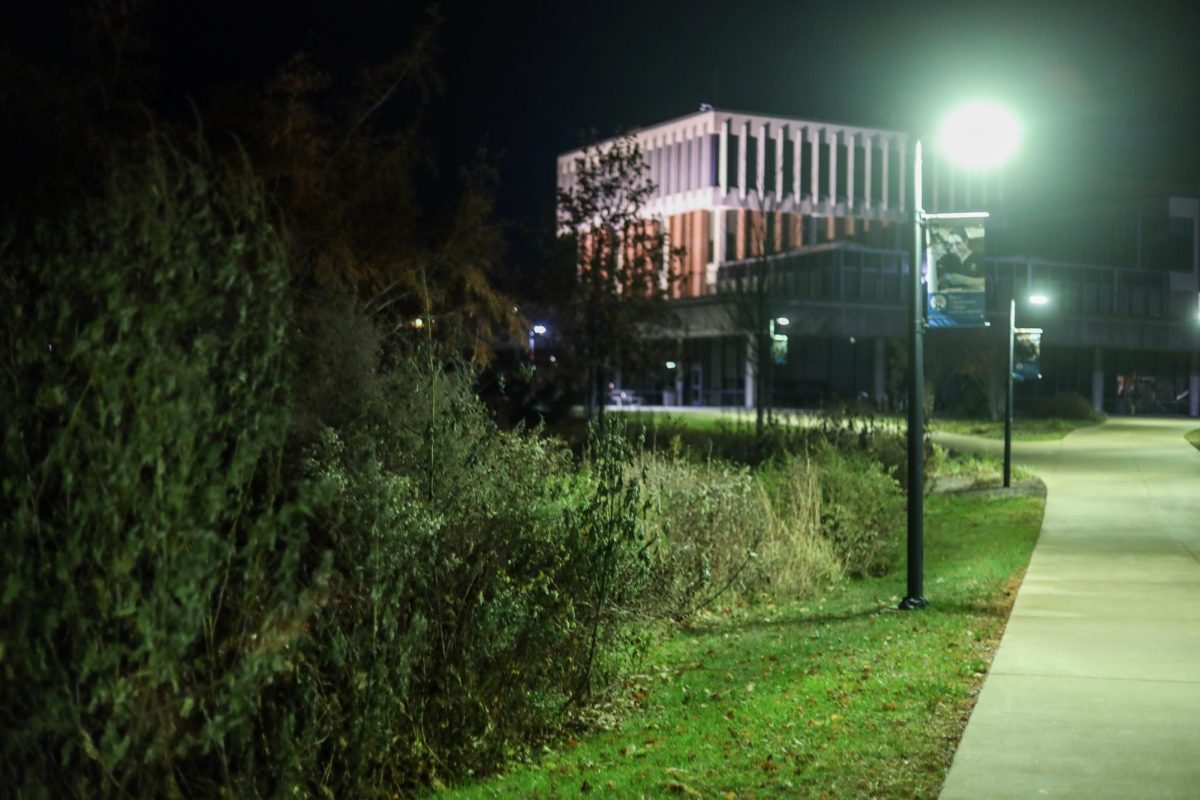
ECC holds these vital plants in multiple locations and even has its own prairie(s) on campus and in a separate campus.
“We have a prairie on the old golf course…along Spartan and McLean Boulevard,” Callahan said. “We have naturalized area up on the second level. The second deck on B [Building B]; there’s two butterfly gardens that are maintained by the biology group. We also have a prairie experimental plot that’s along Spartan Drive as you go west on Spartan Drive past the video screen that’s there.”
There is also “At least 80 acres of previous farmland that we have now kind of turned over to Prairie,” in “Burlington campus,” Callahan said.
While there are more locations of prairie plants at ECC, students can go around campus and observe the plants, working with native species to preserve the ECC environment.