

In the heart of downtown St. Charles, between the Hotel Baker and the Municipal Center, stretches one of the most iconic and controversial landmarks in the town: the dam.
But will it – should it – stay?
A dam is a barrier built on a river or stream to hold the water back. Originally the dams were built to generate power for sawmills and flourmills, however of the Fox dams, only the Dayton one in La Salle county still produces hydroelectricity.
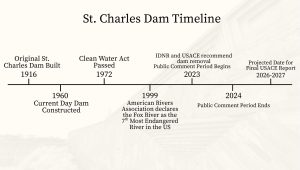
In 2023, the United States Army Corps of Engineers (USACE) and the Illinois Department of Natural Resources (IDNR) released a report calling for the removal of 9 dams along the Fox River including St. Charles, with research saying that the dams were negatively affecting the river ecosystem.
The USACE withdrew its report for further research after a public comment period where there were meetings in the various towns with dams. They are expected to come back with a revised report by 2027 at which time final decisions will be made.

Most of the research conducted seems to agree that removing the dams would lower the water levels and narrow the river. How much, whether or not water levels matter, and other factors to consider are hotly debated by activists from both sides of the dam removal issue.
Gary Swick, a former environmental educator is the president of Friends of the Fox River (FOTFR) a non-profit dedicated to conservation and advocacy for the Fox River Watershed. FOTFR supports dam removal, on the grounds that it would restore the river habitat to better heath.
“In 2001 the Fox was designated as an impaired waterway. And so that’s a status under the Clean Water Act, a federal legislation, and it’s like being in an endangered plant or an endangered animal. To save it mandates that a plan has to be made, and implement it… and according to the research they’ve done in over 20 years the only practical way to address the other foreign impairments is dam removal” said Swick.

The Fox River Study Group, a coalition made up of representatives from various organizations (including FOTFR) and municipalities that are impacted by the Fox River, found five foreign impairments in the water: low dissolved oxygen, nuisance algae, fecal coliform bacteria, flow modification, and phosphorus.
On the other side of the issue is another non-profit: The Fox River Preservation Society. FRPS is a grassroots organization made up of St. Charles residents with a sole purpose to advocate for the maintenance of the St. Charles Dam, and the pool (also called an impoundment) that has formed behind the dam, known as the St. Charles Pool.
FRPS member Todd Surta describes how the river ecosystem has evolved around the dam to create a unique habitat that would be destroyed if the dam were removed.

“Mother Nature has had 196 years to dial in the aquatic species, the mammals, the birds, to the depth of water that’s out here now,” he said. “Human beings, we evolve at a 70 year, 80 year cycle, depending on how long you live to be. Those creatures evolve much quicker. The ecosystem on this pool of the Fox River is dialed in for this pool and its depth.”
Surta has lived on the river for 27 years and owned riverfront property for 35. One of the reasons he and Fox are against taking out the dam is because they believe that more recent data should’ve been used in the USACE study.
“The newest information is 20 years old, and some of it is 30 and 40 years old,” said Surta.
Maryanne Fox is a riverfront property owner who went to several of the public meetings held in 2023, and is against removing the dam. She agreed with Surta. “A lot of the research they’ve done has been based on things that are like 20 years old. So I’m not so sure if they can tell me, once they rip it out, what we’re going to be left with.”
“I’ve also seen pictures of Carpentersville, the Carpentersville Dam they took out, and it doesn’t look pretty. And I won’t live long enough for it to be flowing naturally, and all the wildlife, and the flowers, and all that. So I just don’t think we should do it” she said.
The Carpentersville dam was removed in November 2024, but low water levels as a result of dam removal exposed a pipe running along the river’s bottom. This has caused Elgin residents to express concerns about how dams removed in cities upstream of them would affect their city water.

According to the city’s website, Elgin (which is directly upstream of St. Charles) gets approximately 75% of its water from the Fox River, with the rest drawn from deep wells.
Swick said the Elgin city water system already needs to be renovated regardless of dam removal because the intake is located right by Tyler Creek which deposits a lot of sediment into the system.
“It could be a threat if it’s not addressed. But so will lower water levels from a changing climate as well. So that’s a legitimate concern, being able to provide drinking water. But it’s been addressed by the city” he said.
On the other hand, Surta said Elgin has determined that removing the dam would create problems for the water supply.
“Now they’re going to have to spend $16 million to get water. Who’s paying for that?” he said.
A letter from the IDNR stated that if a dam comes out, federal funds combined with state funds will cover the entire cost of removal. If a dam stays, the state will cover some of the cost, but a large chunk will be left to the city.
Modification options such as a stepped spillway, or a rockfill are also being considered as opposed to full removal.
Looking forward, the future of the dam hangs in the balance. According to Surta, the USACE is expected to come out with a revised report in early 2027 in which community members may have the opportunity to voice their opinion.