

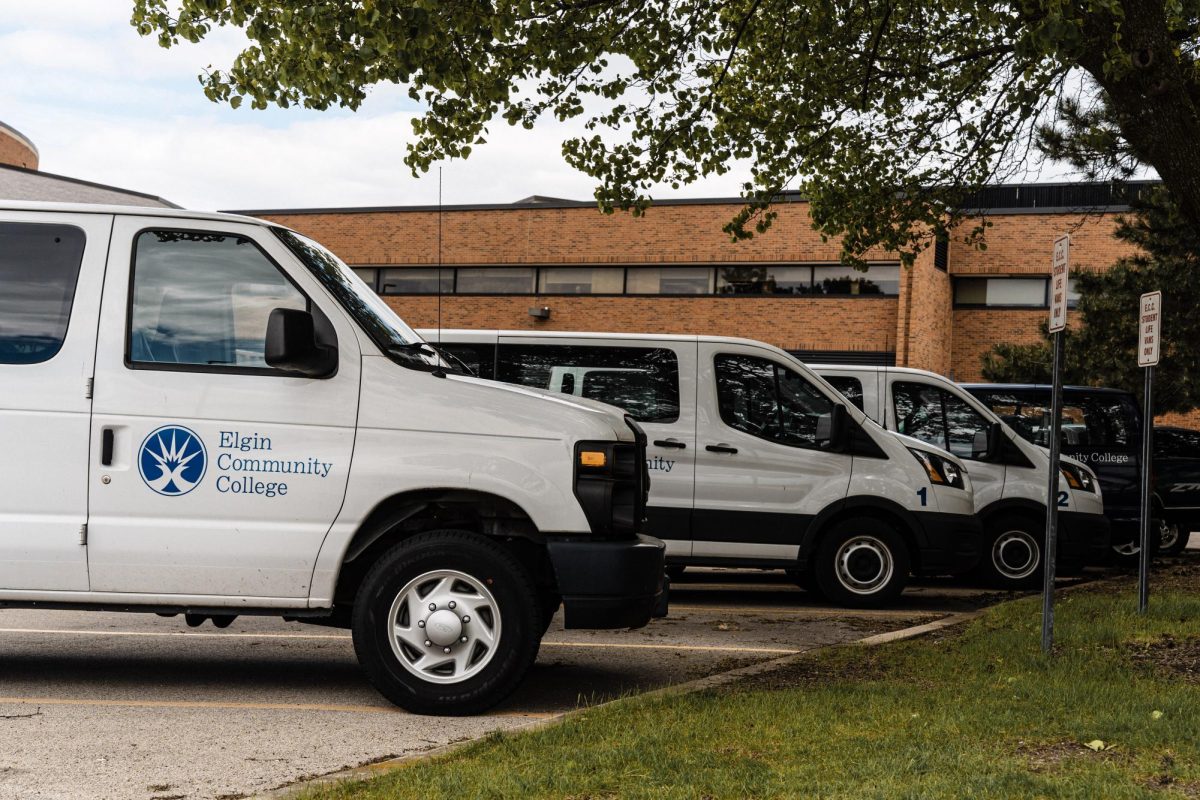
While transportation is required for Elgin Community College (ECC) academic programs, student events, or off-campus activities, students bring attention to how the college supports students with physical-related needs.
Transportation-related accommodations may involve accessible vans, wheelchair lifts, specialized seating arrangements, or coordination with public transit services.
At ECC, disability-related accommodations are coordinated through the college’s disability services program; leaders work with students who have documented physical, learning, sensory, or medical disabilities
“They haven’t reported any concerns to me,” said Pietrina Probst, ECC’s director of Student Access and Disability Services.
Martin Bautista, an ECC student who uses a wheelchair, shared his positive experiences using the transport campus provides.
“It worked,” Bautista said in reference to the van. “We had seven people riding in it, and it had a chairlift.”
At colleges and universities, transportation is a critical factor when students participate in school-sponsored activities. Accommodations are often essential for students who rely on wheelchairs, walkers, or other mobility aids.
“We have one wheelchair accessible van. We’ve only had one situation where we were not able to accommodate a student, and it was a timing issue,” said Amybeth Maurer, the Assistant Dean of Student Life at ECC. “Otherwise, we’ve had the van accessible for when students needed it.”
“There was one event,” Bautisa said, “and I found another way around.”
“It’s on our summer list to review our travel and van policy,” Maurer said. “But we do have a new field trip request form that is electronic.”
That form has a question about accessibility needs.
The current van request form does not currently include a section for identifying accessibility or accommodation needs. There is no designated space to note requests related to mobility assistance, wheelchair access, assistive devices, or other transportation accommodations that may be needed. Adding this information could help ensure transportation requests are addressed more effectively for all individuals.
Administrative Procedure 4.405 outlines approval requirements, timelines, and responsibilities for ECC field trips to ensure student safety.
Federal disability laws, including the Americans with Disabilities Act of 1990, require public institutions to provide reasonable accommodations and equal access to programs and services.
According to the ADA, public colleges cannot exclude students with disabilities from participating in programs because transportation is inaccessible.
“At this time the need does not exceed or does support funding more accessible vans,” Maurer said. Additionally, Maurer indicated that there are no financial obstacles preventing the purchasing of additional vans for Elgin’s campus.
Under ADA Title II, public colleges must provide “reasonable modifications” when necessary to avoid discrimination. The law requires transportation services operated by public entities to be accessible to individuals with disabilities. According to the U.S. Department of Justice institutions cannot deny participation because transportation is inaccessible.
When a college provides transportation services, it is mandated that such offerings remain reasonably accessible to those with mobility-related disabilities—specifically ensuring those utilizing wheelchairs, walkers, or other assistive technology can participate without barriers.
If transportation is provided for field trips, athletics, internships, student organizations, or other school-sponsored activities, ECC is required to ensure students with disabilities can participate equally. As conversations about accessibility continue nationwide, transportation remains an important part of creating an inclusive campus environment for all students.
“We want to ask employees and students to make us well aware of their needs in writing,” Maurer said. “There is a place on the field trip form that asks students about the special needs that they have, so those are places that are kind of like opportunities to do that.”
![[File photo] First semester Industrial Engineer Student Josiah Matthews discusses how he enjoys the challenges that come with complex math problems with staff writer Viviana Avila. Photo Taken in the D building Hallway](https://elginobserver.com/wp-content/uploads/2025/09/Josiah-Matthews-1-Math-1200x800.jpg)
![[FILE PHOTO] ECC's TRiO services on March 24, 2026, are currently available Monday-Thursday from 8:00 a.m-7:00 p.m, and Friday from 8:00 a.m-4:00 p.m. TRiO is one of the few offices available to students enrolled in night classes.](https://elginobserver.com/wp-content/uploads/2026/03/IMG_8423-1200x800.jpg)