


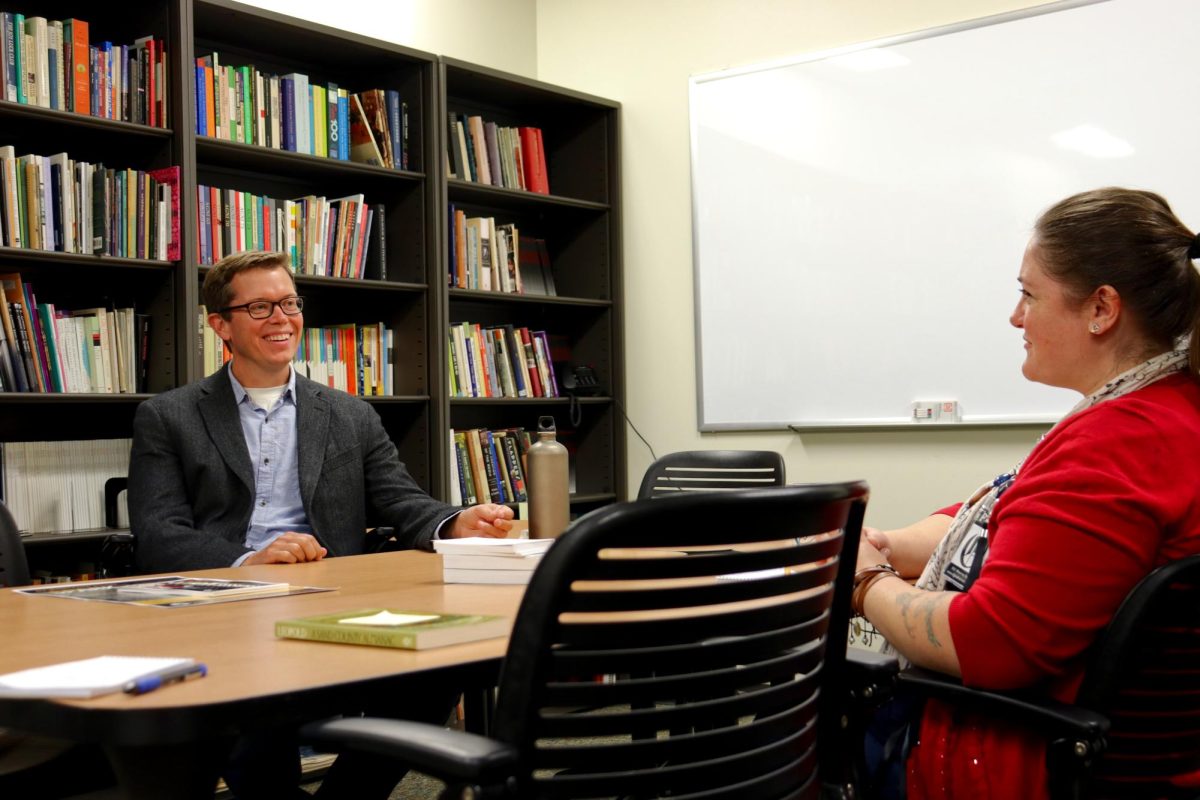
Finding humor on the other side of anger, English Professor Joshua Thusat spoke on how to find your writer’s voice on Wednesday, August 27th, 2025, in the Writers Center.
Q: “Sometimes we do write in a place of emotion, and sometimes those emotions might be more anger driven. How do you, for someone who might be sitting down and wanting to share a piece about their experience, guide them in, don’t write and publish from a place of anger… it’s for yourself and not like a place of trying to get back or make your side of a story?”
A: “Right? That’s a good question. I think one of the reasons it was hard to write it for so many years before I read that book (Vivian Gornick’s The Situation and the Story), and had some more ideas, was the emotional part right? Like it’s early on, a lot of it probably came across as very much like a diary where I was. I was just angry and frustrated about things that happened and my own emotions that I couldn’t contend with or quell. Then as you get older, you know, you start to achieve a little bit of distance from it and the distance does help. It doesn’t necessarily mean you can write it. I think journaling helped because you know when you do a lot of journaling as a writer, most of it’s not going to end up in any piece that’s going to be published, but you find sometimes you’ll find the voice that you need to tell that story. And I think that’s the hard thing to help somebody discover because the voice kind of works as a medium. And we know that, like when you find the voice, it’s a part of you, but it’s not all of you. So, it kind of filters the anger, the frustration through that voice. And you’ll find, like, you’ll discover odd things, like the anger becomes humor. And, you know, humor can be distancing in and of itself, but it also can allow us to have the conversation.”

Q: “It sounds like there’s work even before the piece that probably takes place. For yourself and to develop that, that voice and find that that right voice, that would be good for sharing?”
A: “But if you find it, it’s not always confined to just the one piece. I’m sure David Sedaris writes in a voice that isn’t always the voice he speaks in. Often when you open his book, it’s that voice. I think once you find that voice, it allowed me to write other pieces.”
Q: “Is there anything else you feel you would like to state… about the writing journey that you took?”
A: “I think the writing I feel that I’ve done that is, in short, small supply, has been stuff that I was brave about sharing.”





Nancy Rascher • Oct 14, 2025 at 4:51 pm
Hello Joshua,
I am an Elgin resident eventually moving into an Assisted living situation. My mother was an English literature major at Northwestern university in the 1920s……. I now have a vast collection of her books to include 10 volumes of Eugene field., almost 20 volumes of Dickens, several volumes of Richard Kipling and individual books of an interesting nature. I am trying to find a good home for these tomes. The majority have been published in the late 19th century or early 20th century. I am not sure of their monetary value, but I feel they are too precious to give to Goodwill…… I am thinking that someone in the English educational field would be interested in them and that is why I am reaching out to you….. I belong to two organizations here in Elgin who have the worthwhile project of helping to send high school students on to university so I would ask for a bit of a donation for these books. Nothing enormous, but just a bit…….. here is my point of contact if you are interested in any of these books or know of someone else who might be…..331-222-6422.
John • Sep 3, 2025 at 7:33 pm
I appreciate the kinds of questions being asked here – the interviewer did a great job. I wish I could’ve seen more of the questions and his responses, though!