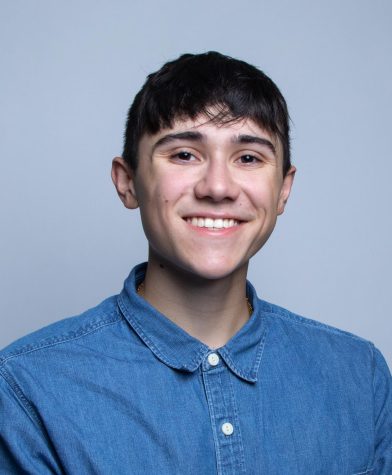


Cathy Taylor, Dean of Sustainability, Business and Career Technologies, shares her thoughts and intentions on the new Manufacturing and Technology Center being built on campus for fall 2026.
Q: With such an upgrade in space and size for the new Manufacturing building, what are some new opportunities for students and faculty that will be made available with the completion of this building? How many jobs could this provide?
A: “The building we’re sitting in right now is roughly 60,000 square feet, the building we’ll be moving to will almost triple the size at 150,000 square feet…we’re going from roughly 17,000 ft^2 of space for instruction to over 55,000 square feet for instruction…we’ll be able to add more sections to our schedule…every semester we have a waitlist for welding…we’ll be able to add roughly 60% more student enrollment opportunities in our welding program alone. At the same time, we are growing our enrollment for our other four programs that are going into the building…the other programs include the HVAC program, Energy Management program, the Maintenance Tech program and the Manufacturing program…we’ll be adding additional programming…in the Manufacturing program we’re adding a Quality Control Technician certificate to that program because there’s a greater need for it in the industry… We’re in the business of providing individuals to fill jobs…we’re adding a Pipe Welding program and ideally this program is structured in such a way that students will be able to get the basic skills that they need to matriculate then to Local 597 The Pipe Fitters, down in Mokena Illinois.”

Q: In what ways do you plan to, or how have you already, made changes to the curriculum of classes to meet the needs of current industries, and how will you uphold these standards to nurture a possible pipeline of skilled workers for the economy?
A: “So each one of the programs we’ve already discussed has what’s called an advisory committee meeting, and on those advisory committees are industry partners who meet with us once or twice a year, and sometimes in between semesters, to talk about some of the things that are occurring in their industry that we can then bring back and integrate into our curriculum. One perfect example of that is E.V. Technology. We’ve secured grants through the Illinois Community College Board Rev Up… and we’ve secured grants through the Illinois Green Energy Network (I.G.E.N) to expand our programming in Energy Management, so that we can now address some of those needs in E.V. Technology… These are the areas in which we are working with industry partners to say, ‘Okay, let’s enhance our curriculum, let’s build capacity’, so that as we move into this new building, we’re thinking about the future, while addressing our current needs.”
Q: Through your research on Culturally Responsive Leadership, will there be any specific features, either in the building’s construction or in the class curriculums, to make this building and fields more accessible to students of diverse backgrounds?
A: “By us being an HSI (Hispanic-Serving Institution), we’re always looking for opportunities…when I wrote the program development for two new pieces of curriculum…there was an opportunity for me to explain the percentage of Latinx students and other under-represented students that are enrolled in these programs, and there is a high percentage. So, from a culturally responsive leadership standpoint, what I’m now charged with is making sure that we have, not so much programming, but that we have at least competencies in terms of leadership and how we want to work with our faculty to ensure that students feel a sense of belonging when they’re in those classrooms. So that students feel that their voices matter. The challenge for us right now Michael, is translating what we’re doing here on this campus, to the workforce. Because we can make opportunities for our students in the classroom, but when they go into the workforce, what’s that experience like… there’s a lot of translation that students will have when they leave ecc to go into the workforce. Those are things that are out of our control right now, but it is a part of an initiative that I’m very passionate about… ensuring that we have that type of sensitivity in our classrooms.”

Q: Is the construction of the building itself on time?
A: “Yes! We are on time… we have to be ready to offer classes in the Fall of 2026, so whenever the first day of classes are in August of 2026, we’ll be open and ready to go!”
Q: Is there anything we haven’t covered that you want students to know about this building?
A: “I will say this, there will be a lot of area in this building for student collaboration and interaction, so in addition to that 55,000 square feet of learning space we talked about, there’s also a lot of open areas for students to come, sit and be involved… There are ded
icated spaces throughout the building that allow that collaboration to happen. So when that collaboration is occurring I also foresee opportunities for students to be more innovative, I see opportunities for students to capture, if you will, the essence of the future of manufacturing. So, while this may be for manufacturing students, I also don’t see anything that prohibits a student from… any other program on this campus, to be a part of what’s happening at the M.T.C. because that’s going to be an innovative center. It is going to be a place where we can capture a lot of things that are on the forefront of what the future of even education could be. So, I open up the doors to any student on this campus who wants to come into the M.T.C and be a part of what’s going to be happening over there. In the words of a lot of folks.. Get’ch’a jam on, over there! Get’ch’a jam on!”

![[FILE PHOTO] The November print edition gets passed around during an Observer pitch meeting.](https://elginobserver.com/wp-content/uploads/2025/11/newspaper-1200x800.jpg)
![[FILE PHOTO] Student life vans, reserved for trips and other uses, are parked outside Building F, on May 6, 2026. Student life only have one wheelchair accessible van out of all the vans available, making trips that need to accommodate a disabled student challenging.](https://elginobserver.com/wp-content/uploads/2026/05/reversednegatives-06514-1200x800.jpg)
![[File photo] First semester Industrial Engineer Student Josiah Matthews discusses how he enjoys the challenges that come with complex math problems with staff writer Viviana Avila. Photo Taken in the D building Hallway](https://elginobserver.com/wp-content/uploads/2025/09/Josiah-Matthews-1-Math-1200x800.jpg)