

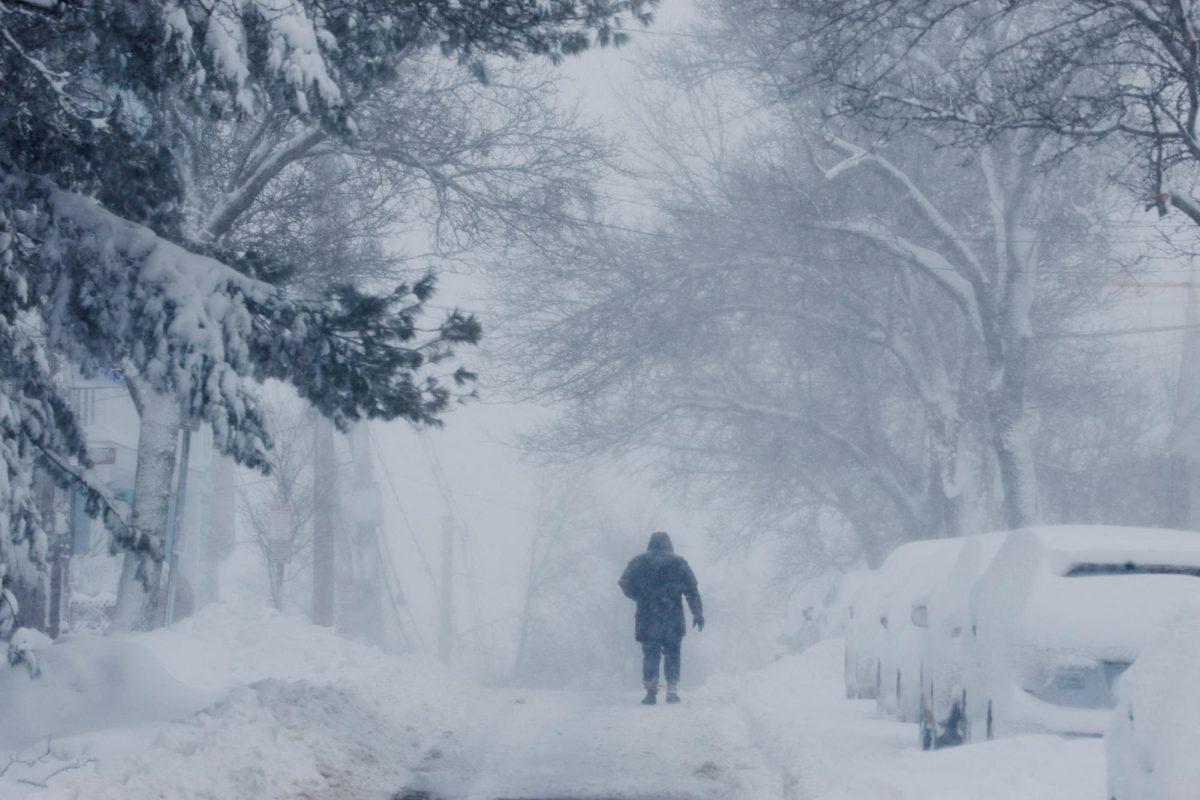
This weekend includes forecast of snow. Chicagoland often experiences lake effect snow, according to the National Weather Service.
During the cold weather, bodies of water can often freeze if the temperature is just right, which can lead to different forms of precipitation falling in that area.
This is called lake effect, which “Forms when cold air moves over relatively warm lakes,” said Professor of Atmospheric Sciences Jeffrey Frame for the University of Illinois.
Although it is called lake effect, it can occur in different bodies of water.
“It doesn’t have to be lakes; it can also be, for example, the ocean, or basically cold air that moves over any relatively warm large body of water, and it’s precipitation that forms from that,” Frame said.
To form in the first place, the temperature would need to be cold for the majority of the time.
“It would need to be below freezing, so below 32 degrees Fahrenheit,” said PhD student Ann Sinclair for the Department of Earth and Planetary Science Climate Change Research Group at Northwestern University.
Lake effect can also come in different forms other than snow.
“It’s most commonly reported in the form of snow, of course, but you can also get Lake Effect rain,” Frame said.
When it comes in the form of snow, there are a few steps that take place before it can take effect.
First, “You have cold air that’s very dry, moving over a sort of warmer body of water,” Sinclair said.
After that occurs, the air above the lake absorbs water coming from it.
“The air will sort of absorb a lot of moisture from that lake, kind of like a sponge,” Sinclair said.
Once this step is done, the air then moves onto land.
“Then you have this air that’s full of water. Essentially, when it moves over land, it gets cold again, and it all falls as snow,” Sinclair said.
At the end of this, there would be a “Really high accumulation of snowfall that can happen right on the edges of lakes,” Sinclair said.
Lake effect can come in two forms as well.
“We have the two main types, the single band and the multi band,” Frame said.
The single band often covers the entire lake, leading to more intense snowfall.
“So when the winds are blowing down the long axis of the lake, oftentimes what happens is you get this one very strong single band of snow,” Frame said.
This then leads, “To several feet of snow coming in off of that,” Frame said. While “Multiple bands coming in tend to be less intense.”
When it comes to the rain, however, the side effects differ.
If it rains, “Long enough and heavy enough, you could get some flooding,” Frame said.
Compared to Lake effect snow, it can look more like a thunderstorm.
“Lake Effect rain does tend to produce a little more lightning, and sometimes can produce waterspouts out over the lake; those are just the tornadoes over water,” Frame said.
Although lake effect rain can contribute to flooding, lake effect snow can have greater impacts.
This includes: “Roof collapses… With that much snow, hindering travel, people getting stuck on interstates, and so forth. Air travel can be affected by that. Train travel can be affected from that,” Frame said.
Although there can be detrimental impacts that come from lake effect, people still can utilize it as an advantage to partake in activities such as those sports.
Winter sports such as “cross country skiing or downhill skiing” can be possible from the Lake effect, Frame said.
![[FILE PHOTO] The November print edition gets passed around during an Observer pitch meeting.](https://elginobserver.com/wp-content/uploads/2025/11/newspaper-1200x800.jpg)
![[FILE PHOTO] Student life vans, reserved for trips and other uses, are parked outside Building F, on May 6, 2026. Student life only have one wheelchair accessible van out of all the vans available, making trips that need to accommodate a disabled student challenging.](https://elginobserver.com/wp-content/uploads/2026/05/reversednegatives-06514-1200x800.jpg)

![[File photo] First semester Industrial Engineer Student Josiah Matthews discusses how he enjoys the challenges that come with complex math problems with staff writer Viviana Avila. Photo Taken in the D building Hallway](https://elginobserver.com/wp-content/uploads/2025/09/Josiah-Matthews-1-Math-1200x800.jpg)

![[FILE PHOTO] ECC's TRiO services on March 24, 2026, are currently available Monday-Thursday from 8:00 a.m-7:00 p.m, and Friday from 8:00 a.m-4:00 p.m. TRiO is one of the few offices available to students enrolled in night classes.](https://elginobserver.com/wp-content/uploads/2026/03/IMG_8423-1200x800.jpg)