
Adrian Rodriguez works 12-hour days, juggling bills, family responsibilities and an uncertain future. These factors led him to not re-enroll at Elgin Community College this semester.
Rodriguez, a former ECC student, feels that the combination of financial pressure and not knowing what path to take made stepping away from college feel like the best decision for now. His situation reflects a broader trend, as male college enrollment continues to lag behind female enrollment both at ECC and nationwide.
Rodriguez is a part of the 11% decline in male students enrolling at ECC for the 2026 spring semester compared to the 2025 spring semester, according to college data.
According to a 2024 Pew Research Center analysis of U.S. census data, 47% of women ages 25 to 34 hold a bachelor’s degree or higher, while 37% of males do. This includes all racial and ethnic groups.
Looking at nearby colleges shows a similar pattern.
During the 2024–2025 academic year, Harper College reported enrollment of 56% female students and 44% male students. Moraine Valley Community College reported 51% female students and 49% male students.
When seeing this data, it is important to ask, if not college, then where? There are lots of other options after high school. A major alternative to college is trades school.
According to a report done by the consulting firm REVE Consulting, trade school is often looked at as a better alternative to college citing “career readiness” and “minimal student loan debt” as reasons why trades school is seen as a better option to some males.
“I have considered going into a trade,” Rodriguez said. “ I think it’s a way to escape all the student debt, and get an almost guaranteed source of income when you might really need it.”
Rodriguez, 19, isn’t alone in men his age considering, and going into the trades. This mirrors a national trend in both trade participation and male college enrollment.
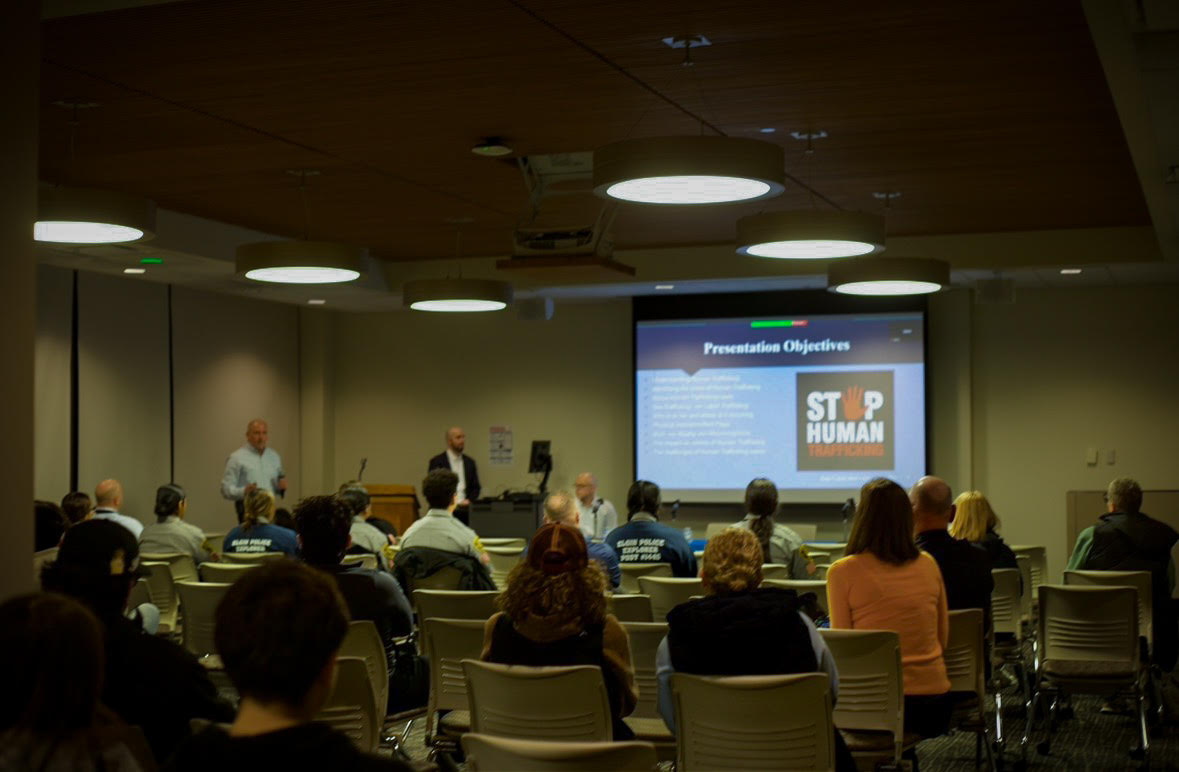
According to Gusto and CNBC, in 2024, roughly a quarter of the new hires in trade industries were 18-to 25-year-olds. These skilled trades include construction, plumbing, electrical contracting and automotive repair.
At ECC, there are programs for trades like automotives, welding, and HVAC. These programs, predominantly male, have seen a major increase in enrollment over a five year period from Spring 2022 to Spring 2026
The automotive program at ECC has seen a 16% increase in that five year period, along with a 2% increase from Spring 2025 Enrollment to Spring 2026 Enrollment.
The HVAC program at ECC has shown a 80% increase in the last five years, and a 19% increase in the last year.
The truck driving program has shown a 62% increase in the last five years, and a 13% increase in the last year.
Lastly, the welding program at ECC continues that trend with a 27% increase over the last five years, but a 2% decrease from last spring to this spring semester.
This shows major trends both nationally and locally at ECC, that trades jobs are becoming more and more popular among the younger generation, as opposed to men taking classes for a degree for a “white collar job.”
Despite the difference in enrollment numbers, along with alternative options post high school, many male students at ECC say the traditional college route was still the clear path forward for them.
Second-year ECC student Daniel Jane and former dual credit student Daniel O’Donnell, both engineering majors, said they chose college over entering the workforce immediately after high school.
“I wanted to go into electrical engineering, and I wasn’t completely ready for a new change of atmosphere to the workforce,” Jane said. “ECC was very convenient for me. It was cheap and nearby.”
O’Donnell said attending ECC made it easier to begin working toward his career goals.
“In pursuing a mechanical engineering degree, I knew college was the only attainable way of reaching that goal,” O’Donnell said. “ECC was an easy pathway for me to both get my high school credits and start on my college credits.”
Second-year dual credit student Jaden Romero shared a similar outlook. Romero, the soon-to-be valedictorian at Hampshire High School, has already been accepted into the University of Illinois Urbana-Champaign’s computer science program.
“My love for computer science and school, along with a bit of pressure from my family, has led me on this path,” Romero said. “No one else in my family has gone down any other path besides college.”
Romero, Jane and O’Donnell all said they have no regrets about their decision to attend college.
While some male students continue to choose college as their path forward, others face challenges that make enrolling or staying in school more difficult. Faculty close to students say those barriers often go beyond academics and are tied to financial pressure, engagement and access to resources.
Erik Enders, student life coordinator for student equity at ECC, said several factors have made enrollment more challenging in recent years.
“The biggest challenge that I’ve seen since I’ve started was COVID,” Enders said. “It impacted students in a lower economic status because there’s a lack of resources and sometimes a lack of awareness of those resources.”
The five-year enrollment data for ECC shows a major dip in enrollment for the manufacturing programs, which are predominantly male, between the spring 2020 and spring 2021.
Enders said the pandemic affected many students’ ability to enroll or remain enrolled, particularly male students.
Enders has worked at ECC for more than six years and leads Triumph, a mentorship program that helps students navigate college and remain on track toward completing their goals.
“It is designed to help students stay here and finish whatever they set out to accomplish,” Enders said. “We do that through increased academic services, and it’s very high touch and intrusive.”
Programs like Triumphant Surge aim to give students access to resources and information they might not otherwise receive while also helping them better understand how they learn.
ECC offers a range of support services aimed at helping students succeed, including academic advising, wellness services and mentorship programs designed to keep students engaged and on track.
Through working closely with students, Enders said he and his colleagues have noticed changes in students, specifically male engagement since the pandemic.
“We’ve seen a drop-off in communication and willingness to engage,” Enders said. “Typically girls are eager to engage and be in school and get their degree, but guys are usually pretty iffy on it.”
Enders believes the college environment provides opportunities that are difficult to replicate elsewhere.
“All of these opportunities are available in this whole contained environment when you come to college,” Enders said. “This is kind of a one-stop shop for all of that development if you come and lean into it.”
Because of this, Enders encourages students to become involved on campus rather than simply attending class and leaving immediately afterward.
“Don’t be a classroom-to-car student,” Enders said. “When you search and seek out a community, that’s when you start to build those relationships and skillsets.”
Rodriguez was a part of that “classroom-to-car” student group and it affected his will to stay in school.
“Not knowing what I wanted to do really made it hard to stay focused and motivated in school, and so I didn’t and it led me to where I am right now.”
![[FILE PHOTO] The November print edition gets passed around during an Observer pitch meeting.](https://elginobserver.com/wp-content/uploads/2025/11/newspaper-1200x800.jpg)
![[FILE PHOTO] Student life vans, reserved for trips and other uses, are parked outside Building F, on May 6, 2026. Student life only have one wheelchair accessible van out of all the vans available, making trips that need to accommodate a disabled student challenging.](https://elginobserver.com/wp-content/uploads/2026/05/reversednegatives-06514-1200x800.jpg)
![[File photo] First semester Industrial Engineer Student Josiah Matthews discusses how he enjoys the challenges that come with complex math problems with staff writer Viviana Avila. Photo Taken in the D building Hallway](https://elginobserver.com/wp-content/uploads/2025/09/Josiah-Matthews-1-Math-1200x800.jpg)