
As construction reaches its end, Elgin Community College’s long-awaited Manufacturing and Technology Center (MTC) will be a new home to four programs: manufacturing, maintenance tech, Heating, Ventilation, and Air Conditioning (HVAC), and welding.
The building has been “eight years in the making,” said Cathy Taylor, Dean of Sustainability, Business and Career Technologies,
“If you think about manufacturing from where it was, let’s say 30 years ago, it’s like night and day,” Taylor said. “Thirty years ago, it was a lot of manual processing; today it’s more automation, more skilled labor, it’s more robotic, and those spaces are cleaner.”
COVID caused another shift in manufacturing.
“COVID came along in 2020, and a lot of companies had to adjust because you no longer had the manual people standing in the shop,” Taylor said. “Now everything has gone to an automated machine. And when it goes to an automated machine, those individuals who were manual [workers] don’t necessarily know how to work the automation, so they’ve got to be reskilled.”
ECC’s manufacturing department saw that as an opportunity to its programs match the needs of what employers are looking for.
In February, Congressman Raja Krishnamoorthi secured $2 million for equipment for the new building, according to an ECC press release. MTC, according to ECC, will have $28.5 million in state funding.
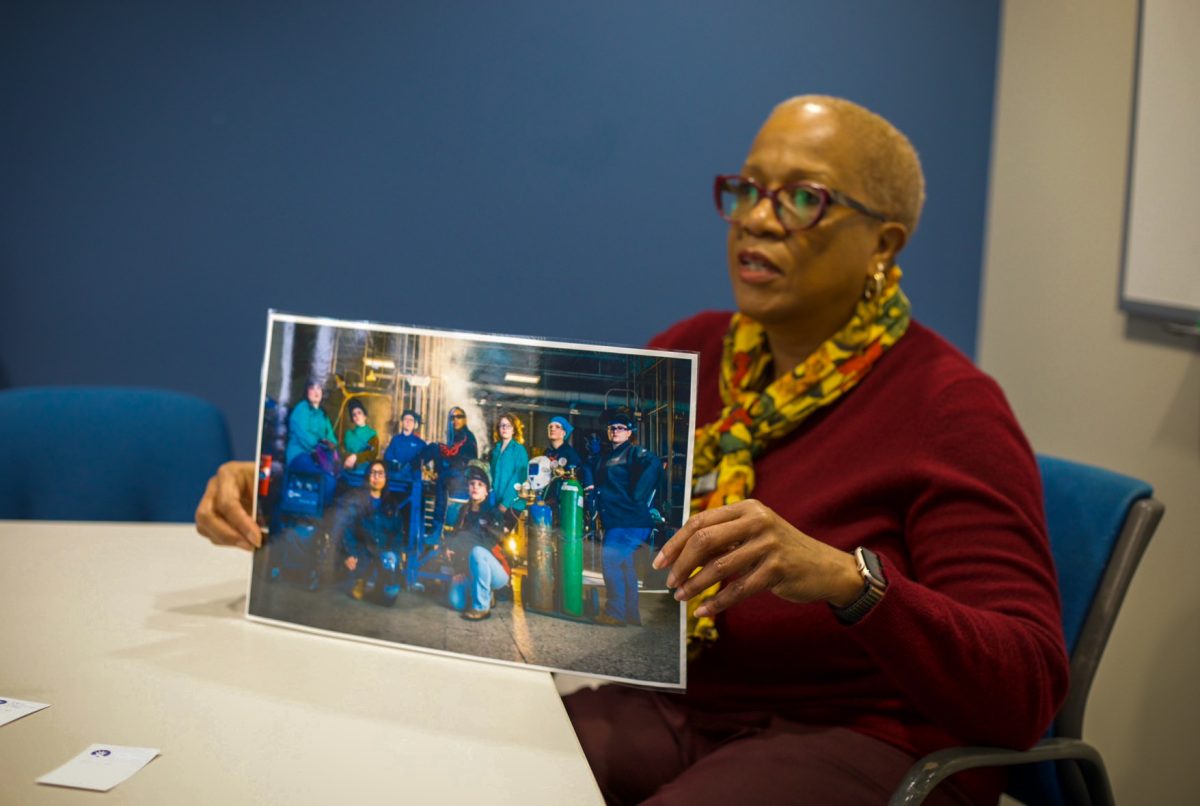
“Our faculty are making requests for state of the art equipment,” Taylor said. “Additional equipment will support our new pipe welding program that we couldn’t offer before because there wasn’t enough space in our current building.”
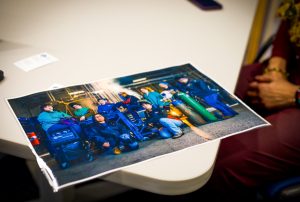
Not only will the M.T.C have more equipment for the students to work on individually, but it will also have monitors that are lifted above the demonstration table so that everyone can see what’s being done.
“Specifically in our welding program, lots of times there will be 15 students all hovering around one table trying to see the demonstration, these monitors will fix that issue,” Taylor said.
Joel Fargoso and Edson Arzate are two first-year ECC students currently enrolled in the HVAC program, and they spoke on struggles with current building and its equipment.
“We could just use a lot more equipment,” Arzate said. “Sometimes we have more than three people for one machine, for example one furnace, so it would be a lot better to just have more so that way everyone could learn individually.”
By creating a building that has more space and equipment, the students believe that it can draw more people to the manufacturing programs.
“I know for sure it would help us a lot, bringing in more equipment, and would for sure make the programs a lot more appealing,” Fargoso said.
Much of these improvements and room for equipment are due to the amount of space that will be in MTC. The 150,000 square-foot building will not just have space for the department and its classes, but space for students to gather.
Taylor described the space for students as a “Jobe Lounge 2.”
“We’ve got space on the second floor where students can hang out and collaborate, and we’ve got whiteboards for that,” she said. “Students can go down to the canteen and grab something to eat and warm it up in the microwave.”
Leaders envisions that as being a popular hub for students from all programs.
“It’s not uncommon for a student to come for a day class, and then they need to stick around for the night class,” she said. “We’ve created these student gathering spaces that make it more comfortable, to hang out for the day if they had to.”
The building will also have a large parking area, on the west side of the building, near a current part of the A parking lot.
“One thing that is really unique about the building is we have a special staircase,” said Tremayne Simpson, Associate Dean of Sustainability, Business and Career Tech. “A stadium seating staircase where students can actually gather and sit on the stairs and hang out.”

Taylor and Simpson said MTC not just ECC, but the entire community.
“This will be a major hub, not just for ECC, but for the entire region, so Elgin and beyond,” Taylor said. “When talking about community, we’re talking about employers, we’re talking about our K-12 partners, we’re talking about our local economic development partners, we’re talking about politicians.”
To the manufacturing department, it is a “regional workforce ecosystem,” Taylor said.
“This building gives us a better opportunity to further connect with area and regional employers and organizations, and to bring more opportunities to our students,” Simpson said. “We will have a workforce development center, as well as a workforce development lab, and space for employers to come in and work with us directly.”
“We are solidifying ECC’s position in our region and demonstrating the workforce ecosystem that must come along with that,” Taylor said.
![[FILE PHOTO] The November print edition gets passed around during an Observer pitch meeting.](https://elginobserver.com/wp-content/uploads/2025/11/newspaper-1200x800.jpg)
![[FILE PHOTO] Student life vans, reserved for trips and other uses, are parked outside Building F, on May 6, 2026. Student life only have one wheelchair accessible van out of all the vans available, making trips that need to accommodate a disabled student challenging.](https://elginobserver.com/wp-content/uploads/2026/05/reversednegatives-06514-1200x800.jpg)
![[File photo] First semester Industrial Engineer Student Josiah Matthews discusses how he enjoys the challenges that come with complex math problems with staff writer Viviana Avila. Photo Taken in the D building Hallway](https://elginobserver.com/wp-content/uploads/2025/09/Josiah-Matthews-1-Math-1200x800.jpg)